The post Safety Net: The Great Dividend Predictor appeared first on Wealthy Retirement.
]]>In 2025, Safety Net was once again an excellent resource for evaluating the safety of a company’s dividend.
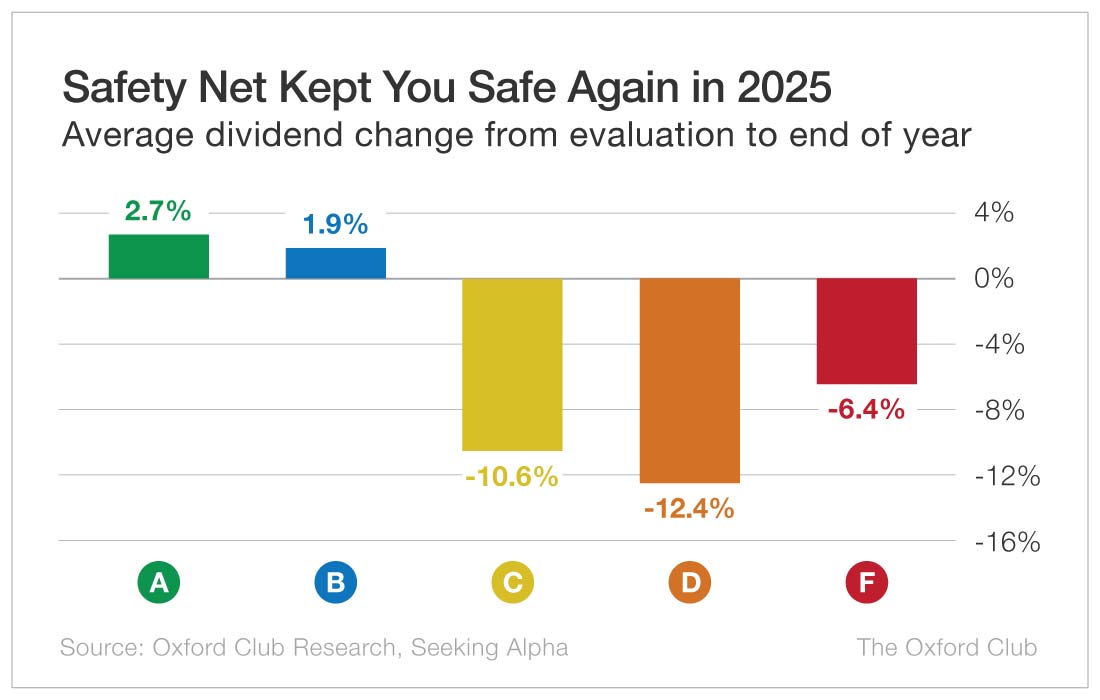
During the year, 10 stocks were rated “A” for dividend safety. None of them cut their dividends. In fact, since 2023, not one of the 29 “A”-rated stocks has lowered its payout within a year after we evaluated it.
Even more impressive, 50% of 2025’s “A”-rated stocks boosted their dividends during the year, including Iron Mountain (NYSE: IRM), which raised its dividend by 10% six months after my “A” rating was released, Delek Logistics Partners (NYSE: DKL), which raised its distribution each quarter, and MPLX (NYSE: MPLX), which hiked its payout by 12% less than a week after I gave it an “A” rating.
I only gave four stocks a “B” for dividend safety in 2025, but two of them boosted their dividends, while the other two kept them the same. There were no cuts.
Energy Transfer (NYSE: ET) was rated “B” in April and raised its distribution every quarter in 2025.
There were seven stocks whose dividends were considered to have a moderate risk of being cut, receiving a “C” rating. Two raised their dividends; two cut them. The average change to the dividend of those seven stocks was -10.6%.
There were a handful of cuts among the “D” and “F”-rated stocks as well. We gave 12 stocks a “D” grade, and 17 others were rated “F.” Two out of the 12 “D”s lowered their dividends, while three out of the 17 “F”s did so.
“D”-rated stocks had the biggest average drop at 12.4%. “F”-rated stocks only saw a 6.4% average decline, but that number is skewed a bit by one variable dividend that saw a sizable – yet likely temporary – increase.
Back in February, Stellantis (NYSE: STLA) slashed its dividend by more than 50% a week after I issued a “D” rating on the stock.
Advanced Flower Capital’s (Nasdaq: AFCG) dividend wilted in 2025. After I gave it a “D” rating, management proved me right by cutting the dividend twice and then skipping it altogether in the fourth quarter.
In June, Research Analyst John Oravec said there was a strong likelihood that OFS Capital (Nasdaq: OFS) would “have a repeat of 2020 with a cut coming down the line” before slapping the stock with an “F” rating. The dividend was cut in half in December.
All in all, it was another terrific year for Safety Net.
Thanks to all of you who submitted requests for stocks to be evaluated in the Safety Net column. Keep them coming! Leave the ticker symbols in the comments section below.
You can also check to see if I’ve rated your favorite dividend payer recently. Just type the company name in the search box in the upper-right corner of this page, and hit “enter.”
The post Safety Net: The Great Dividend Predictor appeared first on Wealthy Retirement.
]]>The post 3 Lessons Every Investor Should Know appeared first on Wealthy Retirement.
]]>That’s what happened to me when I took a graduate-level class with one of my mentors in technical analysis, Dr. Hank Pruden.
For those of you who are unfamiliar with the term “technical analysis,” it refers to analyzing a market or an individual asset using charts.
I was expecting to learn about trend lines, bullish and bearish patterns, cycle analysis, etc., in this class. But instead, we dove deep into the psychology of the markets, trying to understand what motivates investors and traders to act the way they do.
Today, there are many institutions that teach behavioral finance, but at the time, it was groundbreaking stuff.
One of the most important concepts is that investors’ behaviors repeat time and time again. There are no guarantees, of course, and every situation will be a little different, but humans can be fairly predictable.
We typically fear the worst just before things get better… and we expect things will always be this good just before they get worse.
This course taught me a number of key ideas that I still use nearly three decades later. Here are a few of the most impactful ones.
Confirmation bias occurs when you focus only on the information that confirms your beliefs. People do this with their political beliefs all the time, and the media plays into it by exclusively giving them information that aligns with their point of view.
In the markets, an investor may believe that a stock is a great buy because they see the company’s products everywhere… which may cause them to ignore the fact that the stock has been in a downtrend all year. Despite the market signaling that things are not great for the company, the investor buys the stock anyway.
I’d bet almost everyone reading this believes they’re a better-than-average driver. In college, I had an argument with a friend about what a horrible driver he was. “How many cars have you totaled?” I asked. (The number was three in the previous four years.) “Yeah, but they were all somebody else’s fault!” he exclaimed.
Enough said.
When things are going well in the markets, investors often confuse a bull market with their own genius and think they’ll know when to get out. Of course, it doesn’t work out that way.
How many times have you been looking for a place to eat and walked past an empty restaurant to wait at a crowded one?
We’ve seen this time and again in investing, like when people piled into dot-com stocks, crypto, cannabis stocks, and meme stocks because that’s what everyone else was doing.
Being aware of these concepts can help you question your own decision making and ensure that you’re thinking critically about each buy and sell.
You can also use stock charts to test your opinion.
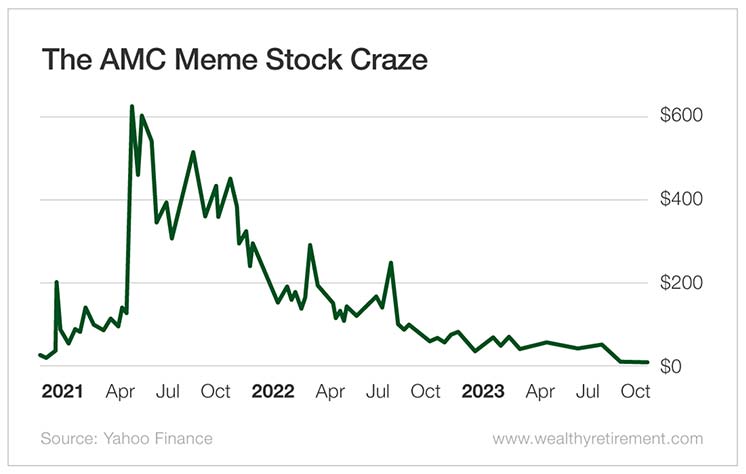
For example, in early 2021, AMC Entertainment Holdings (NYSE: AMC), the poster child for meme stocks, took off. The stock moved from the $20s (split-adjusted) to over $600 in a few months.
And keep in mind, this was not some new tech company or a biotech that had a cure for cancer. AMC is a movie theater chain. And you’ll recall that in 2021, no one was going to the movies. So it made no sense that everyone was piling into the stock.
Let’s say you were on Reddit or some other message board reading about AMC and all the reasons it should go higher. One look at the parabolic move on the chart would tell you to be very careful… because when the stock stopped going higher, it was likely going to reverse quickly.
Technical analysis is simply the visual representation of investors’ emotions. The more aware you are of those emotions and behaviors and how to interpret them, the better a trader and investor you’re going to be.
The post 3 Lessons Every Investor Should Know appeared first on Wealthy Retirement.
]]>The post Novo Nordisk: What’s Next for the Pharma Giant? appeared first on Wealthy Retirement.
]]>In this special “new year” edition of Wealthy Retirement, we’re running a stock through the Safety Net model and The Value Meter… at the same time.
Using these two popular methodologies in tandem – one for dividend safety, the other for valuation – can give us a more complete picture of whether a stock is worth investing in.
Without further ado, here’s the first-ever combined edition of Safety Net and The Value Meter… featuring a company that just made a potentially industry-changing announcement.
Safety Net
Now that the calendar has turned to 2026, lots of folks are making promises to themselves that they won’t keep. However, one resolution just got much easier.
Losing weight.
GLP-1 (glucagon-like peptide-1) drugs have been game changers for patients and the pharmaceutical companies that make them. Now, oral GLP-1 drugs will again move the needle significantly for customers and drugmakers.
Last week, Danish pharmaceutical giant Novo Nordisk (NYSE: NVO) received FDA approval for an oral version of Wegovy, which was previously available by injection only. The change to the company’s financial picture will be momentous.
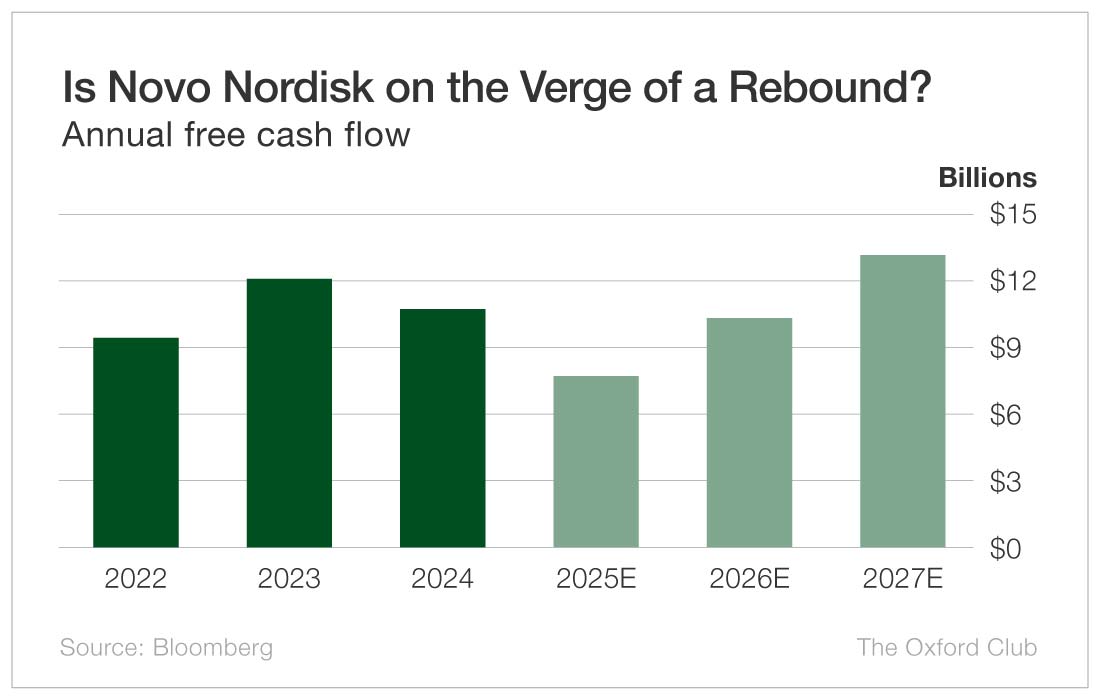
We won’t have the full 2025 figures until next month, but free cash flow is projected to come in at $7.7 billion, a 28% decline from 2024’s $10.7 billion and 36% below 2023’s total.
However, because of the new approval, free cash flow is expected to jump 34% to $10.3 billion in 2026 and another 27% in 2027 to $13.2 billion.
The sharp decline in 2025’s free cash flow costs Novo Nordisk a couple of points on its dividend safety rating.
Another issue is the payout ratio.
Novo Nordisk is expected to have paid shareholders $7.1 billion in dividends in 2025. If free cash flow slid 28% as projected, the payout ratio would rise to 92%, which is way too high.
This year’s projected $8.1 billion in dividends would lead to a payout ratio of 78% based on the consensus cash flow estimate. That is also too high, but it’s within spitting distance of the 75% threshold for Safety Net. If cash flow is a little higher than expected (or dividends paid is a little lower) in 2026, the payout ratio may come in below the 75% level, and the company would not be penalized.
In 2025, American investors received two semiannual dividends totaling $1.73 per share, which comes out to a 3.3% dividend yield.
In its local currency, the Danish krone, Novo Nordisk has raised its dividend for 31 consecutive years – though American investors may have seen slight reductions because of currency fluctuations.
Due to falling cash flow and a too-high payout ratio, Novo Nordisk’s dividend safety rating is low. But this is an unusual situation with the company’s fortunes about to change dramatically due to oral Wegovy.
Combine that with a three-decade run of annual dividend increases and a likely upgrade this year, and the dividend should be okay despite the poor rating.
Dividend Safety Rating: D

The Value Meter
Sometimes the best businesses make only decent stocks – not because the company slips, but because expectations outrun what the cash can reasonably deliver.
That’s the situation with Novo Nordisk today. The business is still excellent. The stock, after a long reset, is finally being treated with more discipline.
The company is the unquestioned global leader in diabetes and obesity treatments. And Ozempic and Wegovy – overnight name brands, it seems – have reshaped how investors think about the company.
For a while, the market assumed that dominance meant inevitability. But recent results remind us that even great businesses have limits.
Over the first nine months of 2025, sales rose 12%, or 15% at constant exchange rates. Operating profit increased 5%, held back by roughly 9 billion kroner (roughly $1.4 billion) in restructuring costs tied to a companywide transformation. Free cash flow came in at 63.9 billion kroner (about $10.1 billion). That’s lower than the previous year, but still substantial.
Capital spending climbed as Novo expanded its manufacturing capacity. That spending isn’t optional. It’s the cost of staying competitive in GLP-1 therapies. Management also narrowed guidance and lowered growth expectations for diabetes and obesity treatments.

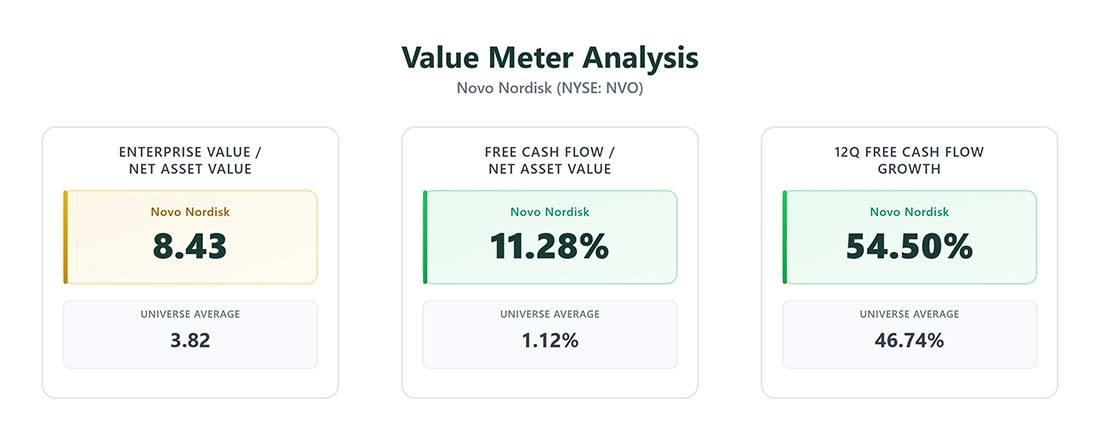
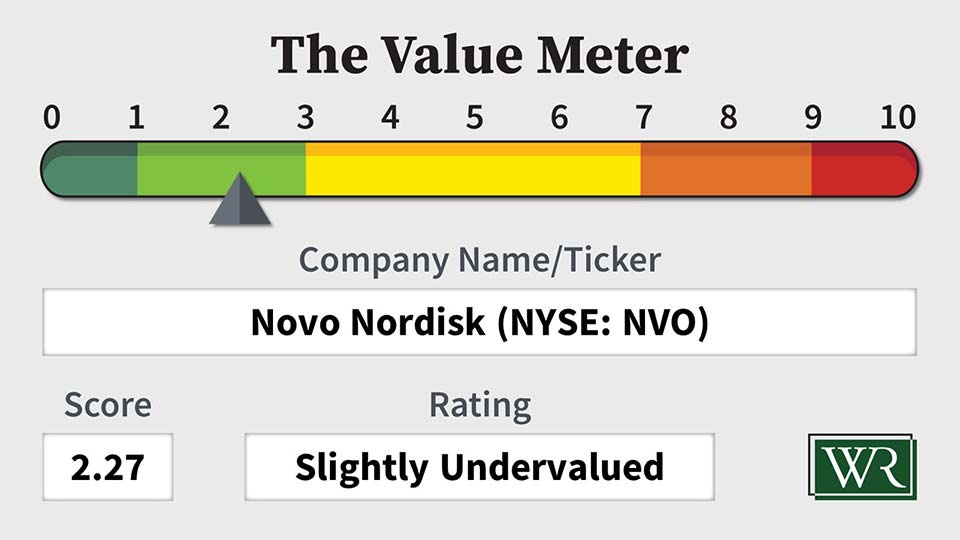
Novo trades at an enterprise value-to-net asset value ratio of 8.43, well above the universe average of 3.82. On that metric alone, the stock still looks expensive. The market continues to pay a premium for quality.
Cash flow is what keeps that premium from becoming a problem. Novo generates quarterly free cash flow equal to 11.28% of its net asset value. The universe average is just 1.12%. In plain terms, the company turns its assets into cash about 10 times more efficiently than the typical company. That matters.
Novo is consistent too. While the Safety Net model rewards year-over-year cash flow growth, The Value Meter prioritizes quarter-over-quarter growth. Over the past 12 quarters, the company grew its quarterly free cash flow 54.5% of the time, compared with 46.7% for peers. It also produced positive free cash flow in each of the past 12 quarters.
This isn’t a lucky stretch. It’s a durable pattern.
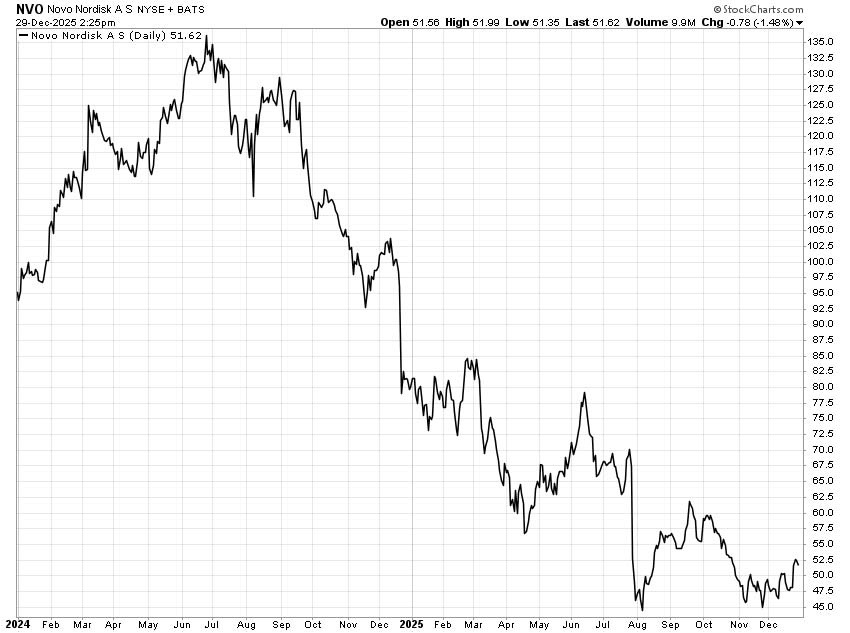
As we saw above, however, the stock has gone through a humbling year. Shares peaked in mid-2024 and slid through much of 2025.
That move wasn’t driven by collapsing fundamentals. It was driven by disappointment. Investors stopped paying for perfection.
That change is important. Novo is not cheap in absolute terms. You are still paying for elite assets. But you are no longer paying as if nothing can go wrong.
The business earns its valuation. The balance sheet is strong. The cash engine is real. What’s different now is the margin of safety. After the sell-off, it finally exists.
This isn’t a stock for traders chasing excitement. It’s for patient investors who want exposure to a world-class cash producer after expectations have cooled. The upside may be quieter from here, but it no longer depends on flawless execution.
The Value Meter rates Novo Nordisk as “Slightly Undervalued.”

The post Novo Nordisk: What’s Next for the Pharma Giant? appeared first on Wealthy Retirement.
]]>The post Learn From “The Einstein of Wall Street” appeared first on Wealthy Retirement.
]]>Our New Year’s resolution in Wealthy Retirement is simple: Continue to deliver insights that can help you prepare for – or improve – your retirement and move one step closer to financial freedom.
One way you can help us do that is to share your feedback.
Could you please take a moment to answer a few questions about your experience with Wealthy Retirement?
It will take less than 60 seconds, and it will help us serve you and your fellow readers even better in the new year.
Thank you in advance!
| Take the Brief Survey Here |
– James Ogletree, Senior Managing Editor
There’s something about the start of a new year that flips a switch.
A clean slate.
A fresh calendar.
And a chance to finally level up a skill you’ve been meaning to master.
That’s why we’re starting the new year with something truly special…
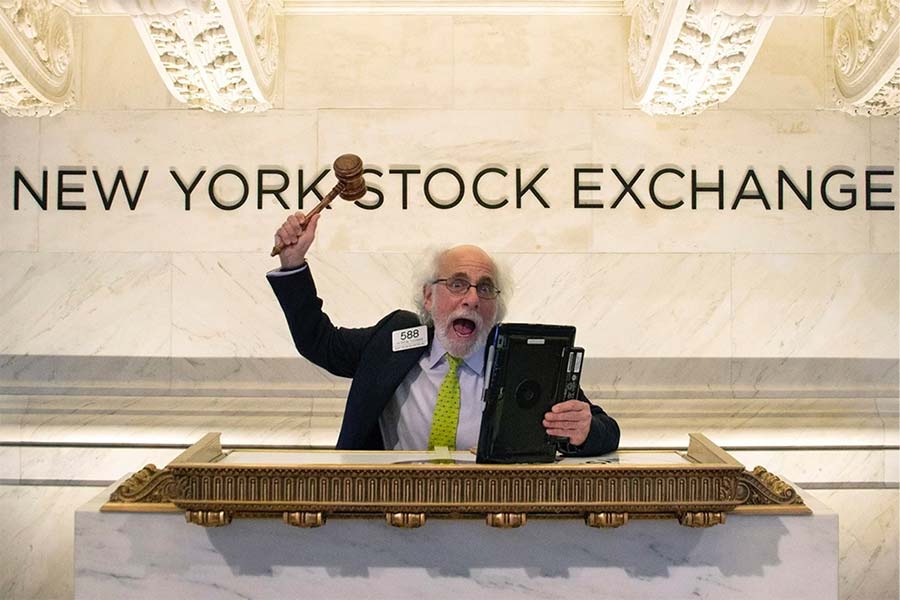
We’re thrilled to announce an Oxford Club exclusive partnership with Peter Tuchman – widely known as “The Einstein of Wall Street” and the most photographed broker on the New York Stock Exchange – alongside veteran trader David Green of Wall Street Global Trading Academy.
If you’ve ever watched market coverage, seen iconic NYSE photos, or followed the pulse of Wall Street over the past few decades…
You’ve seen Peter.
Now, for the first time, Oxford Club readers are getting direct access to him and his business partner David in a FREE live masterclass kicking off the new year.
This isn’t about chasing flashy predictions.
It’s about building a real, rules-based foundation – the kind of knowledge that helps you approach the market with clarity, discipline, and confidence.
In this New Year masterclass, you’ll learn:
If one of your New Year’s resolutions is to:
Better understand the market
Develop new income skills
Or simply stop feeling like you’re “guessing”…
Then this is a powerful way to start.
It’s completely free to attend.
Just click below to add it to your calendar, and we’ll handle the rest.
Add to Calendar (Free Masterclass)
We’re incredibly excited to kick off the new year with The Einstein of Wall Street and Wall Street Global Trading Academy – and even more excited to have you there live.
Here’s to a smarter, more intentional 2026,
Rachel
The post Learn From “The Einstein of Wall Street” appeared first on Wealthy Retirement.
]]>The post How Americans Have Achieved Unprecedented Prosperity appeared first on Wealthy Retirement.
]]>However, we saw the biggest spike in inflation in 40 years during the Biden Administration, thanks to massive deficit spending, near-zero interest rates, and the temporary shutdown of the global supply chain.
Yet “time prices” still came down by the end of 2024, extending the long-term trend.
Between 2000 and 2024, the CPI rose 82.2%.
But hourly earnings for blue-collar workers rose 115.1% – outpacing inflation by more than 40%.
That means an hour of work bought 18.1% more goods and services at the end of 2024 than it did at the beginning of 2000.
That’s progress. Just not the kind that the media bothers to cover.
Unlike money, time can’t be counterfeited or inflated.
There is perfect equality here. We all get 60 minutes in an hour and 24 hours in a day.
Our time is truly our most precious resource, the only one that cannot be recycled, stored, duplicated, or recovered.
When time prices decrease – as they have for decades now – an hour of time buys more products and services.
While people often compare what they make with someone earning more, they rarely stop to realize how much more they can buy today compared with what they could buy in the past for the same hours worked.
Time prices are the one unimpeachable standard to compare abundance from one era to another.
And their fall is not due to an increase in material resources. It is due to the expansion of knowledge, which enables us to use resources more creatively and effectively.
This is a powerful phenomenon, yet one that is not commonly understood.
Being able to afford more while working less is further evidence that most Americans are living the Dream without realizing it.
Most of us take the long-term improvement in our standard of living for granted.
Indeed, there is a common misconception that increasing progress and prosperity have been the norm for as long as human beings have been around.
Yet history reveals that this is decidedly not the case.
Imagine, for example, that the Roman statesman Cicero was magically able to time travel and visit Thomas Jefferson at Monticello more than 1,800 years later.
Cicero would arrive at the coast of Virginia the same way Jefferson would have made the trip to Italy.
He would ride a horse to the nearest port and trust his fate to a windblown ship.
When Cicero arrived at Monticello months later, things would look quite familiar.
Jefferson’s home was heated by fire in the winter, and the doors and windows were left wide open in the summer, the same as in ancient Rome.
Jefferson read by candlelight, drew his water from a well, ate mostly what he raised, used an outhouse, and owned slaves, just like Romans did 18 centuries earlier.
Cicero would learn that four of Jefferson’s six children did not survive early childhood.
Nothing new there. This was sadly the case for most of human history.
(Jefferson’s wife died at age 33 of complications from giving birth to their sixth child.)
Except for a few notable innovations – like the printing press, gunpowder, and the compass – life in 1800 was hardly distinguishable from life almost 2,000 years earlier.
Since then, however, there has been an explosion in human progress and prosperity.
Economic historian Deirdre McCloskey calls it the Great Enrichment, a period of exponential wealth creation that started more than 200 years ago and is still accelerating.
This is plainly visible in the quality of your transportation, the speed of your communications, your many laborsaving devices, and the huge variety of goods, services, and outright luxuries available to you at the click of a button.
Thomas Jefferson did not have electricity, cars, trains, airplanes, radio, television, cameras and video recorders, smartphones, computers, lasers, batteries, the World Wide Web, antibiotics, vaccines, pacemakers, artificial hearts, MRI scans, gene therapies, and countless other lifesaving and life-enhancing innovations.
What is most responsible for our exponential increase in abundance?
Two things: freedom and people.
Freedom is crucial because it allows people to create and profit from their innovations.
(That’s why goods and services have not become cheaper for the average consumer in Cuba, Venezuela, North Korea, and other unfree nations.)
But this phenomenon is not about freedom alone. It’s also about more people. A lot more people.
People generate knowledge. Knowledge multiplies output. And freedom lets people share, trade, and profit from their discoveries.
The freer a society, the greater its time price gains. The more people it empowers, the richer its outcomes.
Scarcity didn’t win. Innovation did.
We have increased food supply, for instance, by increasing yields from existing fields.
We’ve increased our agricultural efficiency so much that less than 2% of the U.S. population farms at all.
After more than a century of intensive fossil fuel use, we have more known deposits of oil and gas than ever before.
(And we’ve surveyed only a tiny portion of the planet.)
Overpopulation is not a threat. On the contrary, limiting population growth limits brainpower.
Yet generations of schoolchildren have been taught that population growth makes resources scarcer.
Indeed, academia and the media repeatedly warn us that we are consuming the planet’s natural resources at an alarming rate… and that they will soon be gone.
Not true. Resource abundance is growing faster than the world population.
Our economy has reached such a level of efficiency and sophistication that we are producing an increasing amount of goods and services while using ever-fewer resources.
For example, from 2014 to 2024 U.S. real gross domestic product grew by 27.6%.
But, over the same period, energy consumption decreased by 1.3%.
Western countries have learned how to get the most energy with the least emission of greenhouse gases.
As we climbed the energy ladder from wood to coal to oil to gas, the ratio of carbon to hydrogen in our energy sources fell steadily.
As a result, fewer American cities are now shrouded in a smoggy haze.
Our distant ancestors spent most of their waking hours hunting and gathering food to live.
Yet the typical American today earns their food in a matter of minutes. And we are spoiled for choice at the average supermarket.
We have more goods and services available – and work fewer hours to afford them – than any previous generation.
The world today is incomparably richer than it was in decades past.
Yet the doomsayers are unable to see it – or don’t want to.
Instead, they continually warn us that the end is nigh.
As a result, many Americans are unable to enjoy the countless advantages of modern life because they believe it is on the verge of ending – and there is nothing they can do about it.
Don’t buy it. Especially the claims about “overpopulation.”
The most important resource in today’s world is not oil or natural gas or some rare earth mineral.
It’s people. By applying their intelligence and creativity, individual men and women make other resources more abundant.
Additional people don’t just create additional demand. (Although that also promotes growth and prosperity.)
They represent an additional supply of ideas, knowledge, and productive work.
We shouldn’t underestimate the power of this. Or what time prices tell us.
When you spend less time laboring to feed and clothe your family, put a roof over your head, keep the lights on, and pay your bills, you are gaining the ultimate wealth: more time to do what you really want.
This is not just prosperity. It’s superabundance.
And another reason to acknowledge that the American Dream is alive and well – for those with eyes to see it.
The post How Americans Have Achieved Unprecedented Prosperity appeared first on Wealthy Retirement.
]]>The post How to Make Millions by Doing Nothing appeared first on Wealthy Retirement.
]]>The most important element to investing success is not stock-picking ability – it’s time. The longer you’re invested, the more money you will make.
Consider this…
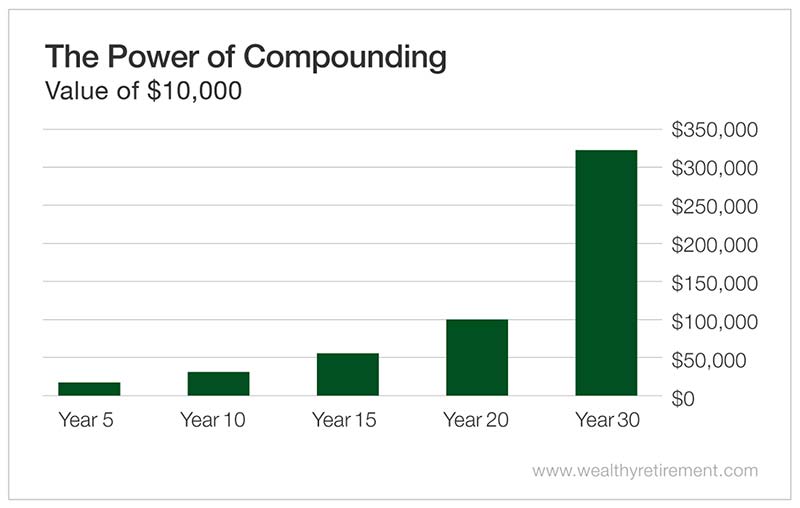
A $10,000 investment in dividend growth stocks with a starting yield of 4%, dividend growth of 8% per year, and price appreciation that rises in line with the historical average of the S&P 500 is worth $17,757 after five years.
After 10 years, it’s worth $31,572.
After 15 years, you’re sitting on $56,208.
At year 20, your $10,000 has turned into $100,195.
Hold for another 10 years, and you’ve got $319,613.
And if you stayed invested for 40 years, you’d have $1,024,893.
That’s the power of compounding and time.
Legendary investor and trader Jesse Livermore once remarked, “It was never my thinking that made the big money for me. It was always my sitting.”
In fact, a Fidelity study commissioned years ago looked at its accounts to see if it could identify common traits among its most successful investors. What it found was remarkable.
The best-performing accounts belonged to investors who either were dead or had forgotten they had accounts.
Among the thousands of accounts that Fidelity looked at, the ones that just sat there – that weren’t touched – had the best results.
The biggest favor you can do for yourself as an investor is to put money into stocks and then do nothing (or very little) for as long as possible.
And if you want to leave a legacy for your children or grandchildren, do the same for them.
Can you imagine how you’ll be remembered if your grandchild has an account that you set up 40 years prior, and that money – which may not have been much when you funded it – can now help them buy a house, fund their child’s education, or even set up the next generation the way you did?
They say that in life, timing is everything.
But in the market, what’s more important is time. Regardless of how tough the markets might be, give yourself and your family the gift of time for your investments to grow.
The post How to Make Millions by Doing Nothing appeared first on Wealthy Retirement.
]]>The post Will the AI Bubble Burst in 2026? appeared first on Wealthy Retirement.
]]>
It seems like no one knows what to think about AI stocks these days.
For every expert screaming “full speed ahead!”, there’s another one warning investors to pump the brakes.
Last week, our friends at MarketBeat invited Chief Income Strategist Marc Lichtenfeld onto their YouTube channel for an interview on this very topic.
Was the recent shakiness in the sector just a blip on the radar… or something more?
How concerned should investors be about buying stocks at 52-week highs?
And most importantly, is AI in a “bubble”… and if so, when will it pop?
Marc answers all these questions during the interview and even provides two free stock picks:
To watch the interview and get Marc’s two free picks, click here or on the image above.
The post Will the AI Bubble Burst in 2026? appeared first on Wealthy Retirement.
]]>The post The Big Inflation Beater appeared first on Wealthy Retirement.
]]>And with more interest rate cuts likely coming and higher tariffs still on the table, I expect inflation to accelerate.
Fortunately, there’s an asset class that has absolutely crushed inflation every decade for nearly a century. And I bet you’ll be surprised when you find out what it is.
It is not gold.
Gold has kept up with inflation over the very long term, but that’s about it. An ounce of gold essentially buys the same amount of goods and services today as it did a millennium or two ago.
The big inflation beater is small cap stocks.
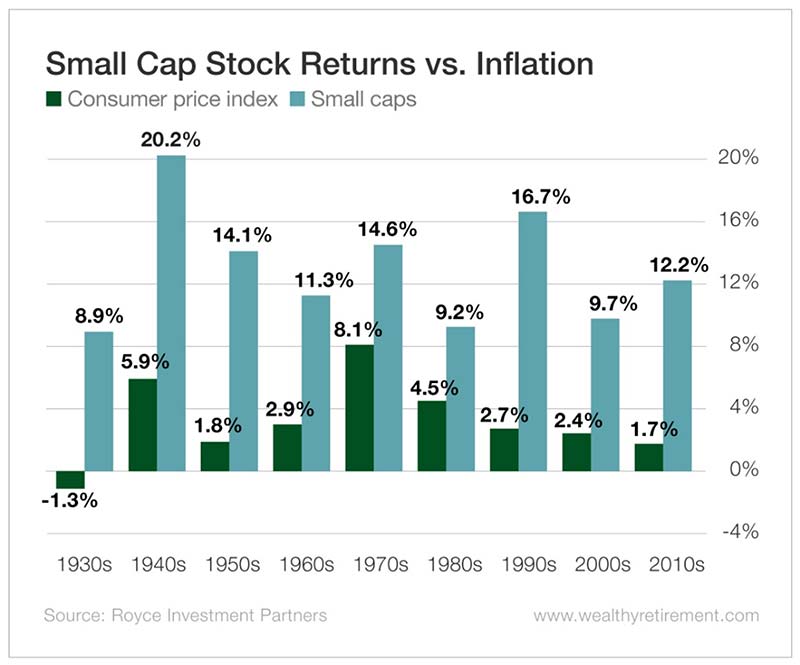
You can see from the chart above that small caps strongly outpaced inflation in every decade. The smallest margin was 4.7% in the 1980s.
On average, small caps returned 13% annually, while inflation averaged 3.2% – meaning small caps increased an investor’s buying power by an astounding 10% per year.
That doesn’t just mean you could have had 10% more money each year. It means you could have bought 10% more goods and services each year – no matter how high prices rose during that year.
To make it clear just how profound this is, let me give you an example. Let’s say you’re a golfer and the average round of golf costs you $100. You have a budget of $1,000 per year for golf (not including equipment). That means you can play 10 times per year.
Now imagine that, due to inflation, a round of golf will cost you $105 next year. If your budget doesn’t increase, you’re down to playing nine times per year. And in a few years, if inflation remains constant, that will decline to eight times.
But now suppose that you added the average yearly return (13%) that small caps have delivered to your golf budget, increasing it from $1,000 to $1,130. Not only would you be able to afford the annual bump in greens fees, but you’d also be able to increase the number of times you can hit the links to 11 per year. You’d be able to play 12 times the following year… and so on.
Small caps get a bad rap. Many investors think they’re super risky. And certain ones are. There are plenty of garbage companies out there.
But as an asset class, small caps have a fantastic track record that goes back decades. And surprisingly, they help investors increase their buying power even during periods of high inflation.
Going forward, it will be important to have small caps in your portfolio. With large caps trading at historically high valuations (and with more rate cuts by the Fed on the horizon), they are likely to be the top performers in the near term.
Many people think of small caps as speculative investments. But they have proven over nearly 100 years to play a vital role in allowing investors to beat inflation and increase their buying power.
The post The Big Inflation Beater appeared first on Wealthy Retirement.
]]>The post AMD Is a Great Story… but Is It a “Buy”? appeared first on Wealthy Retirement.
]]>When a stock dominates headlines and dinner conversations, the easy money is usually gone. That doesn’t make it a bad business. It just means the market has already done the rewarding.
I suspect that may be where Advanced Micro Devices (Nasdaq: AMD) sits today. The company is no longer the challenger it once was. It’s a fixture of the modern tech landscape.
Its chips power servers, PCs, gaming consoles, and now some of the most demanding AI workloads in the world. And investors know this. That’s why the stock price reflects it.
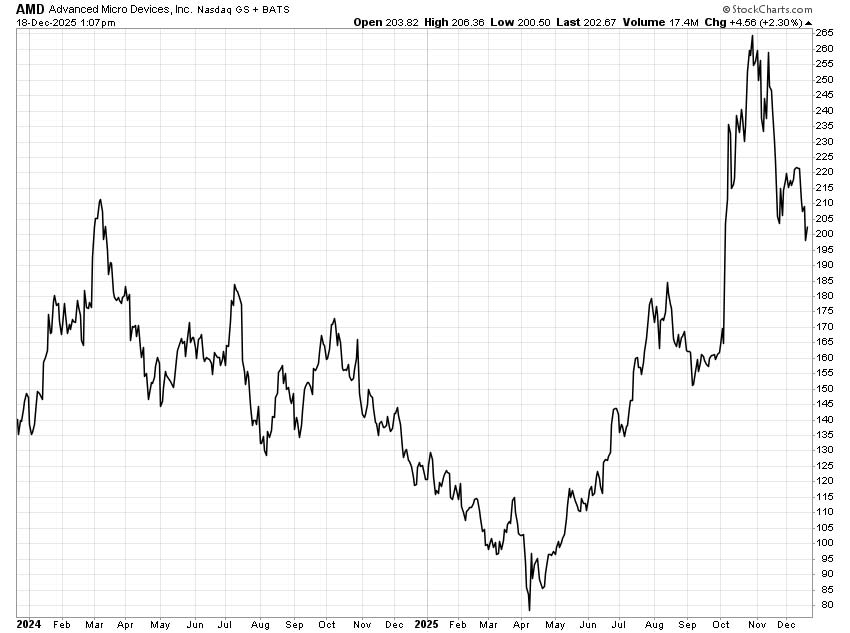
As you can see, after spending much of last year building a base, AMD didn’t grind higher. It surged. Shares leapt from below $80 in April to well above $250 in a short window before volatility set in.
Now, it’s easy to look at AMD and see a “chipmaker.” But that can be reductive.
The company designs high-performance semiconductors across data centers, consumer devices, gaming, and other computation-heavy ecosystems. Nowadays, that means the company sits at the intersection of cloud computing and artificial intelligence.
That’s a powerful place to be – as the market acknowledges. But it’s also a crowded one.
The latest quarter shows that the business is firing on all cylinders. Revenue rose 36% year over year to $9.2 billion, driven by strength in data centers, AI accelerators, and client CPUs. Operating income expanded. Free cash flow hit a record $1.5 billion.
The balance sheet is solid: over $7 billion in cash and about $3.2 billion in debt. AMD has room to invest without stretching itself.
This is a solid business producing great cash flow.
But the question isn’t whether AMD is a great company. (It is.) The real question is whether you’re being offered value at today’s price.
That, of course, is where our handy-dandy Value Meter comes in.

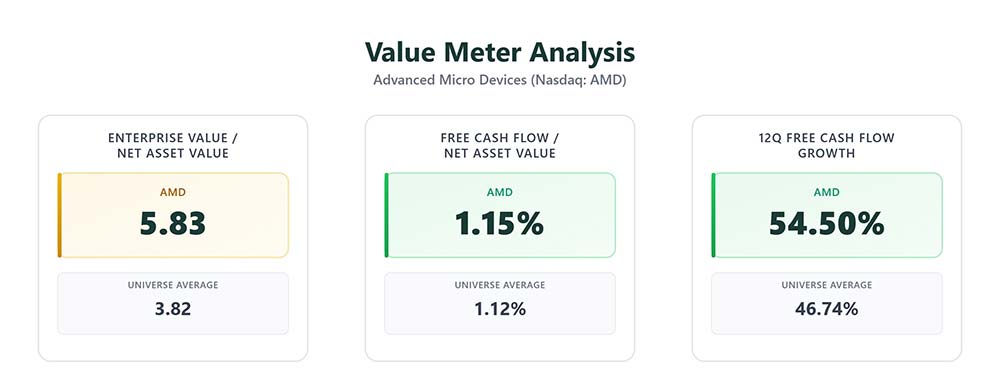
AMD’s enterprise value-to-net asset value ratio sits at 5.83. The broader universe averages 3.82. This tells us investors are paying a premium for AMD’s assets and its future. That premium may prove justified – but it leaves little room for error.
On efficiency, AMD’s free cash flow-to-net asset value ratio is 1.15%, only slightly above the 1.12% average. That’s fine. It’s not exceptional.
Where AMD does stand out is consistency. Over the past three years, it’s grown its quarterly free cash flow 54.5% of the time, well ahead of peers. Execution has been steady. The momentum is real.
In short, AMD has strong growth and solid cash generation… but a valuation that already assumes both will continue.
The stock’s recent run reinforces the point. Much of the upside came quickly, driven by shifting expectations, not neglected value. Early buyers were paid. New buyers are paying attention – and paying up.
For long-term holders, patience still makes sense. The business is strong, and the strategy is intact.
For new capital, discipline matters. The margin of safety is thin, and thin margins tend to show up after sharp rallies, not before them.
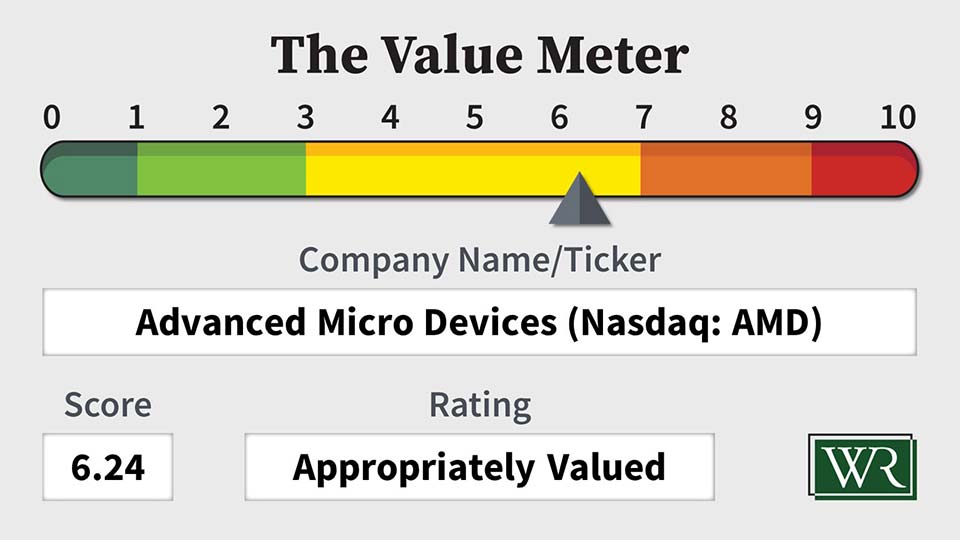
The Value Meter rates AMD as “Appropriately Valued.”

What stock would you like me to run through The Value Meter next? Post the ticker symbol(s) in the comments section below.
The post AMD Is a Great Story… but Is It a “Buy”? appeared first on Wealthy Retirement.
]]>The post Is This Company’s Dividend as “GOOD” as Its Ticker? appeared first on Wealthy Retirement.
]]>Gladstone is a real estate investment trust that owns and rents out 151 industrial and office properties in 27 states.
For example…
Last year, funds from operations (FFO), a measure of cash flow used by REITs, grew by 0.8% to $59.2 million. This year, the growth rate is expected to be nearly identical, as FFO is forecast to rise to $59.7 million. However, that is still lower than 2022’s $60.6 million.
Safety Net wants to see cash flow growth over both one- and three-year periods.
The numbers are close, though, so if FFO comes in a little over expectations, it could show positive growth over three years.
The bigger problem is Gladstone Commercial pays out more in dividends than it takes in.
Last year, the company paid shareholders $62.8 million while generating $59.2 million in FFO. In other words, it paid $1.06 in dividends for every $1 in FFO.
This year, that’s forecast to dip to $1.04.
We always want dividends paid to be below cash flow. Otherwise the company has to dip into cash, borrow money, or sell stock to afford the difference.
Gladstone Commercial pays a $0.10 monthly dividend, which comes out to an impressive 11% yield.
However, there was a cut recently. At the beginning of 2023, management lowered the dividend to the current rate from $0.1254 per share.
So the company can’t afford its dividend, and management showed a willingness to cut the payout less than three years ago.
Until FFO exceeds what the company is paying out, Gladstone Commercial’s dividend is not safe.
Dividend Safety Rating: F

What stock’s dividend safety would you like me to analyze next? Leave the ticker in the comments section.
You can also take a look to see whether we’ve written about your favorite stock recently. Just click on the word “Search” at the top right part of the Wealthy Retirementhomepage, type in the company name, and hit “Enter.”
Also, keep in mind that Safety Net can analyze only individual stocks, not exchange-traded funds, mutual funds, or closed-end funds.
The post Is This Company’s Dividend as “GOOD” as Its Ticker? appeared first on Wealthy Retirement.
]]>